

COVID-19 Rapid Antigen Testing in Palm Bay, FL
At Restore Health Urgent Care Centers, our team provides quick, accurate COVID-19 Rapid Antigen testing to help you make informed decisions about your health and protect those around you. Whether you have symptoms, experienced a recent exposure, or need clearance for work, school, or travel, our clinical team delivers prompt evaluation and testing aligned with current public health standards. For more information, contact us or schedule an appointment online. We are conveniently located at 1840 Eldron Blvd SE. Suite 1 Palm Bay, FL 32909.
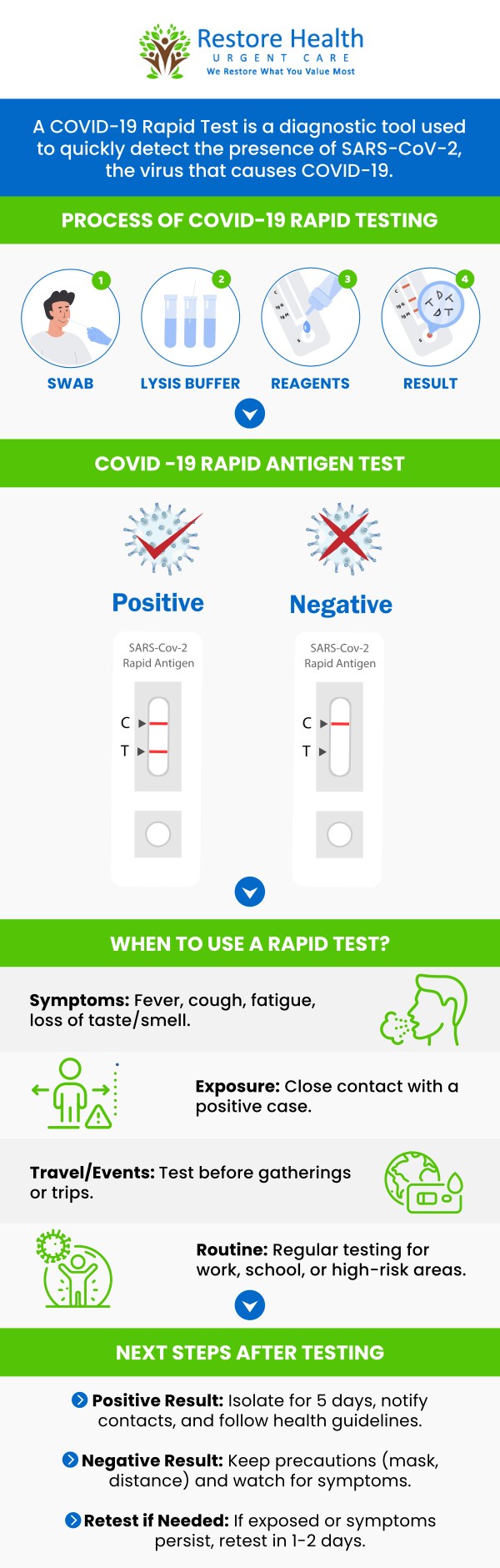
Table of Contents:
What is a COVID-19 Rapid Antigen Test?
How does a COVID-19 antigen test work?
Who may consider COVID-19 antigen testing?
When should I test if I have COVID-19 symptoms?
Can a rapid antigen test be negative even if I have COVID-19?
Should I repeat an antigen test after a negative result?
What does a positive COVID-19 antigen result mean?
What should I do if I have respiratory symptoms?
How soon after exposure will an antigen test detect COVID-19?
How accurate are rapid COVID-19 antigen tests?
Is an antigen test the same as a PCR test?
Can COVID-19 antigen testing distinguish COVID-19 from the flu or RSV?
Why might someone still feel sick after a negative COVID-19 test?
Can I have COVID-19 more than once?
Does having COVID-19 make me permanently immune?
Can antibody or serology testing tell me whether I am immune to COVID-19?
Why is COVID-19 testing especially important for people at higher risk?
Does a positive COVID-19 test automatically mean I need antiviral medication?
When should COVID-19 symptoms be treated as an emergency?
Can antigen testing help before visiting an older or medically vulnerable person?
What should I know before coming to Restore Health Urgent Care for COVID-19 antigen testing?
Medical References
A COVID-19 antigen test looks for specific proteins from SARS-CoV-2. These tests are often called rapid antigen tests because results can usually be obtained much faster than traditional laboratory molecular testing. Antigen testing can be useful when someone currently has symptoms or wants information about whether they may have an active infection.
However, antigen tests are generally less sensitive than molecular tests such as PCR or other nucleic acid amplification tests. This means an antigen test may sometimes be negative even though a person has COVID-19, particularly early in the infection. For that reason, a result should be considered together with symptoms, exposure history, and whether repeat testing may be appropriate.
An antigen test checks a respiratory sample for viral proteins. Depending on the specific test being used, a sample is commonly collected from the nose with a swab. The sample is then processed according to the test manufacturer’s instructions. If enough viral antigen is present, the test produces a positive result.
Because antigen levels change during an infection, timing matters.
Someone tested very soon after exposure may not yet have enough detectable virus for the test to turn positive. This is one reason a negative result does not always mean that COVID-19 has been ruled out.
Testing may be useful for people who develop symptoms that could be caused by COVID-19, especially when the result could affect decisions about medical care or contact with other people.
Common respiratory-virus symptoms can include:
• Cough
• Sore throat
• Runny or stuffy nose
• Fever or chills
• Fatigue
• Headache
• Muscle or body aches
• New loss of taste or smell
• Vomiting or diarrhea
People without symptoms may also consider testing in certain circumstances, such as after a known exposure or before close contact with someone at higher risk of severe illness.
If COVID-19 symptoms develop, testing can be performed promptly. Testing may help determine whether COVID-19 is contributing to the illness and may be particularly important for people who have a higher risk of severe disease. A single negative antigen test should not automatically be treated as proof that COVID-19 is absent.
The FDA recommends repeat testing after a negative antigen test because the virus can be missed early in an infection. People who remain ill despite negative COVID-19 tests may also have influenza, RSV, or another respiratory infection and may benefit from medical evaluation.
Yes. False-negative antigen results can occur. Antigen tests are less sensitive than molecular tests, particularly when viral levels are still low. This can happen during the early stages of infection or in people without symptoms.
A negative result therefore means that the test did not detect SARS-CoV-2 antigen in that particular sample. It does not necessarily prove that the virus is absent. Symptoms, recent exposure, timing of the test, and the likelihood of infection should all be considered when deciding whether repeat or molecular testing is appropriate.
Repeat testing can be important. Current FDA guidance recommends repeat antigen testing after a negative result because serial testing reduces the chance that an early infection will be missed.
For FDA-authorized at-home antigen tests, people with symptoms are generally advised to test at least twice over three days, with approximately 48 hours between tests.
People without symptoms are generally advised to test at least three times over five days, again with approximately 48 hours between tests. Patients using a specific test should also follow that test’s current FDA-authorized instructions.
A positive antigen result usually indicates a current COVID-19 infection. Someone who tests positive should take steps to reduce the chance of spreading the virus to other people and should pay attention to symptoms.
Current CDC recommendations for respiratory illnesses focus on symptoms rather than a fixed 5-, 10-, or 14-day isolation period for most people in the community.
People at higher risk of severe COVID-19 should contact a healthcare professional promptly because antiviral treatment works best when started early.
People who develop symptoms of a respiratory virus should generally stay home and away from other people while they are actively sick. Under current CDC guidance, normal activities may be resumed once symptoms have been improving overall for at least 24 hours and any fever has been gone for at least 24 hours without fever-reducing medication.
For the next five days, additional precautions can help reduce transmission. Depending on the situation, these may include good ventilation, careful hand hygiene, a well-fitting mask, physical distancing, or testing before being around other people.
An antigen test may not detect COVID-19 immediately after exposure. After SARS-CoV-2 enters the body, it takes time for the amount of virus to increase enough to become detectable. Testing too early may therefore produce a negative result even if an infection is developing.
For people without symptoms who know they were exposed, timing recommendations depend on the test and current public-health guidance. Repeat testing can improve the chance of detecting an infection that was missed initially. People who develop symptoms after exposure should test when symptoms appear and take precautions to avoid exposing others while sick.
Antigen tests can be useful for detecting active COVID-19, but they are not perfect. They are generally more likely to detect infection when the amount of virus in the respiratory tract is higher. Molecular tests such as PCR and other nucleic acid amplification tests are typically more sensitive.
A positive antigen result is usually meaningful when the test has been performed correctly. Negative results require more caution, especially when symptoms or a recent exposure make COVID-19 likely. Test accuracy also depends on correct sample collection, proper storage, expiration dates, and following the manufacturer’s instructions.
No. Antigen and molecular tests look for different parts of the virus. An antigen test detects viral proteins. A PCR or other nucleic acid amplification test detects the virus’s genetic material. Antigen testing can provide rapid information and may be convenient when timely results are important.
Molecular testing is generally more sensitive and may be appropriate when greater diagnostic certainty is needed. The better test depends on why the person is being tested, when symptoms began, recent exposure, and how the result will be used.
A COVID-19-only antigen test does not determine whether someone has influenza or RSV. COVID-19, influenza, RSV, and other respiratory infections can produce similar symptoms, including cough, fever, fatigue, congestion, headache, and sore throat. Symptoms alone cannot always distinguish one infection from another.
If a COVID-19 test is negative but symptoms continue, medical evaluation may help determine whether another respiratory infection should be considered. Some diagnostic products can test for more than one virus, but availability and the exact tests used by Restore Health Urgent Care should be confirmed with the clinic.
A negative COVID-19 antigen result does not necessarily identify the cause of an illness. Possible explanations include testing too early for COVID-19 to be detected, another respiratory infection such as influenza or RSV, or another medical condition entirely.
If symptoms continue, worsen, or become concerning, relying repeatedly on a single type of home or rapid test may delay appropriate evaluation. A healthcare professional can assess symptoms in context and determine whether additional testing or treatment should be considered.
Severe or rapidly worsening symptoms require prompt medical attention.
Yes. Reinfection can occur. Previous infection may provide some immune protection, but that protection varies between individuals and changes over time. New SARS-CoV-2 variants can also affect the likelihood of reinfection.
It is therefore inaccurate to assume that someone cannot get COVID-19 again simply because they previously recovered from the infection. If new respiratory symptoms develop after a previous episode of COVID-19, testing and medical evaluation may still be appropriate.
No. COVID-19 infection does not provide guaranteed or permanent immunity. The immune response following infection varies from person to person and may decrease over time. Viral evolution also means that immunity from an earlier infection may provide less protection against a later variant.
For this reason, a previous COVID-19 infection should not be treated as proof that future infections are impossible. Current vaccination recommendations and individual risk factors should be discussed with an appropriate healthcare professional when needed.
Not reliably. Antibody, or serology, tests detect antibodies produced after infection or vaccination. They are different from antigen and molecular tests, which are used to detect a current infection.
An antibody result should not generally be used to determine whether someone currently has COVID-19. It also should not be interpreted as a simple measurement of whether a person is protected from future infection. Immune protection involves more than the antibody level measured by a routine serology test.
Testing can be particularly useful for people with risk factors for severe COVID-19 because treatment decisions may need to be made quickly. Risk generally increases with age and may also be higher for people with certain chronic medical conditions or weakened immune systems.
Effective antiviral medications are available for some people at higher risk, but they must be started early in the illness. Depending on the medication, treatment generally needs to begin within approximately five to seven days after symptoms start. A person at higher risk should therefore contact a healthcare professional promptly when COVID-19 is suspected rather than waiting for symptoms to become severe.
No. Antiviral treatment is generally intended for people with mild or moderate COVID-19 who have risk factors that increase the chance of progressing to severe illness. Eligibility depends on factors such as age, medical history, immune status, kidney or liver function, pregnancy considerations, current medications, and potential drug interactions.
A positive result is only one part of the decision. A qualified clinician should determine whether treatment is appropriate for an individual patient.
COVID-19 and other respiratory illnesses can occasionally become serious. Emergency medical attention may be needed for symptoms such as severe trouble breathing, persistent chest pain or pressure, new confusion, inability to stay awake, or other signs of severe illness.
Children may have different warning signs, including difficulty breathing, bluish lips or face, dehydration, seizures, or unusual difficulty staying alert. These examples are not a complete list. Anyone with severe or rapidly worsening symptoms should seek emergency evaluation rather than waiting for routine testing or an urgent care appointment.
It may provide additional information, particularly if someone recently had symptoms or a possible exposure. However, one negative antigen test cannot guarantee that a person is not infected or unable to transmit COVID-19. Testing is most useful when combined with other reasonable precautions.
When protecting someone at increased risk of severe respiratory illness, additional measures may include avoiding contact while sick, improving indoor ventilation, practicing good hygiene, using a well-fitting mask when appropriate, and following recommended repeat-testing instructions.
How long does a COVID-19 antigen test take?
Rapid antigen tests generally provide results much sooner than laboratory molecular tests, although the exact processing time depends on the test used.
Does one negative antigen test rule out COVID-19?
No. COVID-19 can be missed by an antigen test, especially early in an infection, so repeat testing may be recommended.
Where is Restore Health Urgent Care located?
Our clinic is located at 1840 Eldron Blvd SE, Suite 1, Palm Bay, FL 32909.
Restore Health Urgent Care offers COVID-19 antigen testing at its Palm Bay location at 1840 Eldron Blvd SE. Suite 1 Palm Bay, FL 32909.
For more information, contact us or schedule an appointment online. Because testing products, testing requirements, pricing, insurance coverage, and availability can change, patients who need testing for a specific purpose such as employment, travel, school, or an official document should confirm current requirements before their visit.
Patients with severe or life-threatening symptoms should seek emergency medical care instead of routine urgent care testing.
We serve patients from Palm Bay FL, Melbourne FL, Malabar FL, June Park FL, Grant-Valkaria FL, and surrounding areas. Walk-ins Welcome.
Check Out Our 5 Star Reviews

Additional Services You May Need


 Send Text
 How May I Help You?